
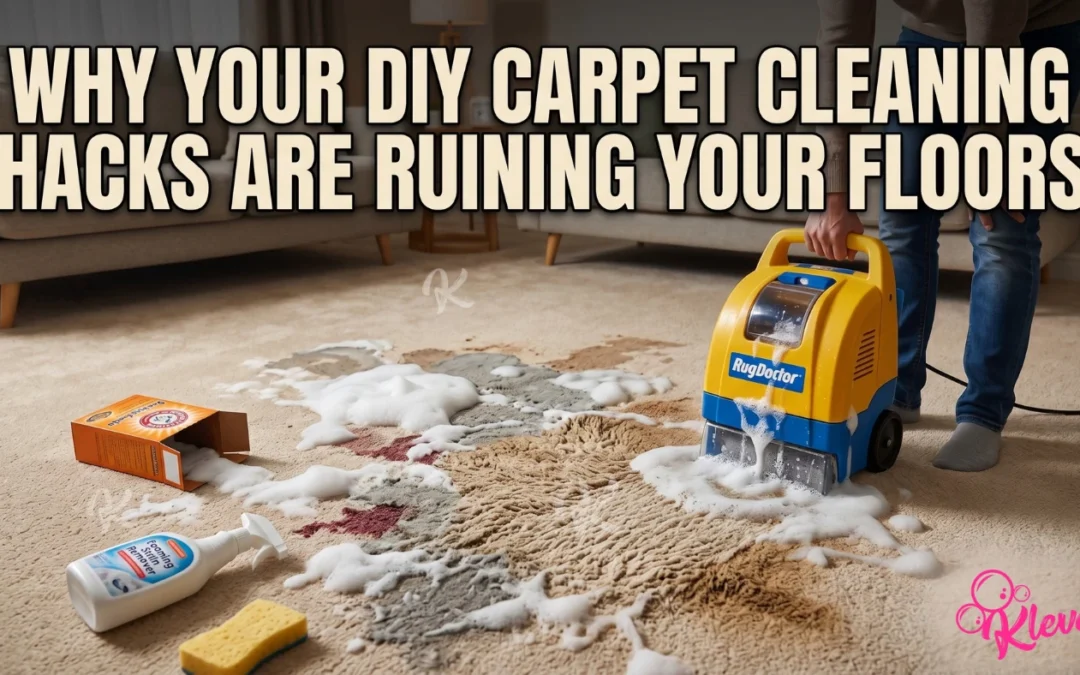
Why Your DIY Carpet Cleaning Hacks Are Ruining Your Floors
We've all been there.
It's a Sunday afternoon, you've got mates over, and someone tips a glass of red across the lounge carpet. Or your dog has a little "oopsie" moment right in the middle of the brand-new wool you've barely had down six months. You panic. You grab your phone. And before you can blink, you're 20 minutes deep into TikTok watching some random in their kitchen mix dish soap, vinegar, baking soda, and hot water like they're Walter White brewing up a miracle.
I get it. The instinct is to do something, and fast.
But here's the straight-up reality: those DIY quick-fixes don't clean your carpet. They actively destroy it. Your carpet is a 15 to 25-year investment in your home — a serious chunk of money that, when looked after properly, should outlast most of the furniture sitting on top of it. Playing backyard chemist with stuff from the pantry is the fastest way to turn that investment into landfill.
I've lost count of how many times I've rolled up to a job in our bright pink van, scanned a spot with the UV light, and seen the tell-tale blurry outline that screams: "Someone tried to fix this themselves." The good news? Most of these disasters can be undone if you stop early enough. The bad news? Plenty of them can't.
Let's break down exactly why these internet hacks are a terrible idea, what's actually happening in the chemistry of your carpet, and what you should be doing instead.
What do people prinkle on the carpet before vacuuming?
Baking soda. The internet's favourite "magic trick."
Sprinkle it on, leave it overnight, vacuum it up — boom, fresh carpet, right? Wrong. Here's the science behind why that's a disaster.
Your wool carpet, when it's healthy, sits in a slightly acidic state — somewhere around pH 5 to 6. That mild acidity is exactly what keeps the pile fluffy, soft, springy, and naturally stain-resistant. It's how the fibre was designed to live. Baking soda, on the other hand, is highly alkaline with a pH of around 9. That's a massive shift in chemistry.
Putting alkaline baking soda on a delicate wool carpet is exactly like using a harsh gravel scrub on delicate skin. It strips the natural oils, crushes the pile, makes it feel crunchy underfoot, and — worst of all — leaves a sticky alkaline residue that locks in dirt and old stains rather than lifting them.
And then there's the vacuum problem. Baking soda is a fine, powdery substance. It's smaller than the dust your vacuum was designed to handle. So when you suck it up, it slips straight past the bag, into the motor, and into the filter. I've had customers hand me a vacuum that's "stopped working" and out comes a cloud of white powder. That's a vacuum heading for an early grave.
Worse still? When we turn up to do a proper clean afterwards, that high-alkaline residue can react violently with our professional acidic textile rinses. Foaming. Discolouration. Sometimes we have to clean the carpet twice just to undo what the baking soda did.
In other words, step away from the pantry!
Why does my carpet look dirtier after shampooing?
Good question — and this one trips up just about everyone.
You scrubbed at a stain with foaming dish soap and warm water. The stain disappeared. You felt like a hero. Then a week later, a dark patch appears in exactly the same spot, often bigger than the original mark. What gives?
Dish soap is designed to do one thing: cling to grease and food residue so it can be rinsed off a smooth, hard plate under running water. The key word there is rinsed. Your dinner plate gets a flood of clean hot water afterwards. Your carpet does not. So when you use foaming dish soap on carpet fibres, it leaves behind a sticky soapy residue deep in the pile that you can't possibly rinse out with a sponge.
That residue is a literal dirt magnet. Every footstep over the next week presses fresh dust, dander, skin cells, and grit straight into the sticky patch. Within days, you've created a darker stain than the one you were trying to remove.
Here's the analogy that lands every time. Trying to wash grease out of a carpet with lukewarm water and dish soap is exactly like trying to clean a roasting pan full of bacon fat in a cold sink. You smear it around, you make a soapy mess, and the grease just relocates. Now imagine that pan never gets a hot rinse — it just sits there, sticky, collecting dust on the bench. That's your carpet.
And there's a second layer to this problem. Dish soap is alkaline. Same problem as the baking soda — you're shifting the pH of your carpet in the wrong direction, crushing the pile and inviting more soiling.
What not to do when shampooing carpet?
Two big rules: don't scrub, and don't overwet.
Let's start with scrubbing. When you grab a sponge, a brush, or — heaven help us — a stiff-bristled scrubber and start going at a stain like you're sanding back a deck, you are not removing the stain. You're doing three things, and all of them are bad:
1. Pushing the stain deeper into the fibres, often past the face yarn and into the backing where no DIY cleaner can reach.
2. Spreading the stain wider, turning a 5cm spot into a 20cm halo.
3. Damaging the fibre tips — physically fraying the wool or nylon, which permanently changes the way that area reflects light. Even after we get the stain out, that patch can look duller forever because the fibres themselves are wrecked.
Always blot, never scrub. Work from the outside of the spill inward. Use a clean white cloth so you can see the colour transferring out.
Now, overwetting. This is the silent killer.
Pouring vinegar, water, or any DIY potion onto carpet to "rinse it out" does not rinse anything. There's nowhere for that water to go. It seeps straight through the face yarn, through the backing, and into the underlay below. In Auckland's humid climate — especially through autumn and winter — that trapped moisture takes days to evaporate, sometimes weeks. And while it's sitting in there, it's doing two things you absolutely don't want.
First, it's becoming a breeding ground for mould and bacteria. That musty smell you can't quite locate? Yep.
Second, it's causing something called cellulosic browning. The jute backing on most quality carpets is extremely hydrophilic — it grabs water and holds onto it. When that water finally migrates back up to the surface as the carpet slowly dries, it brings dissolved tannins and oxidised compounds with it, leaving permanent yellow-brown stains across the surface. Reversing browning needs an acidic chemical treatment most homeowners don't have. I get calls about this all the time, especially after Rug Doctor weekends.
How do I deep clean my carpet myself?
You want the straight-talking answer? You shouldn't. Properly, you can't.
Those "deep clean" portable machines you can hire from the supermarket — Rug Doctor and the like — are basically toys dressed up as professional gear. I'm not bagging them to sell you a service; I'm telling you because I've measured what they actually do.
Here's the problem in three parts:
They don't get hot enough. Real cleaning chemistry runs on something called Arrhenius's Equation — for every 10°C increase in temperature, chemical activity roughly doubles. Our truck-mounted Titan 325 hits 98.9°C at the wand. Rug Doctors run at lukewarm tap temperature, maybe 40°C if you've poured a kettle in. That's the difference between melting through grease and just smearing it around.
They don't have enough suction. A weak portable vacuum can pull up maybe 60% of the water it lays down. The other 40% stays in your carpet and underlay. Our truck-mount has its vacuum motor running off a petrol engine outside in the van, with industrial-grade hoses pulling against atmospheric pressure. We extract everything we put down, plus the dirty water that was already in there.
They use weak, supermarket-grade chemicals. The little bottles of solution you buy at the hire shop are often heavily perfumed, packed with optical brighteners, and full of soaping agents that — you guessed it — leave that sticky residue we talked about earlier.
The end result of a DIY portable clean is a carpet that's overwetted, soapy, alkaline, and primed to re-soil within weeks. It looks decent for about 48 hours and worse than before within a month.
Sometimes doing less is genuinely better. If you spill something, blot immediately with a clean white cloth and a tiny bit of cold water. Don't add anything else. Then call us.
What does WD-40 do to carpet?
I had to read this one twice the first time I saw it on Reddit.
WD-40 on carpet. As a stain remover. People are recommending this with a straight face.
Look — WD-40 is a petroleum-based lubricant. It's brilliant on a squeaky hinge or a stuck bolt. It is not a cleaning product, and it has no business going anywhere near textile fibres.
Will it displace certain marks, like ink or scuff residue? Sometimes, yes — for about 24 hours. What it leaves behind is the real problem: a heavy, oily, sticky residue soaked deep into the pile. And petroleum residue does not evaporate. It sits there, attracting dust, dander, foot grit, and pet hair like a magnet, until you've got a permanent black greasy patch right in the middle of your lounge.
Even worse, oil residues on synthetic carpet fibres can cause permanent staining because the oil migrates into the fibre itself rather than just sitting on top. Once that's happened, even a hot-water extraction with proper solvent won't fully reverse it.
The TikTok hack saved you from a 5mm pen mark and gifted you a 30cm grease patch. Genius.
What are common carpet cleaning mistakes?
Three big ones, in order of how often I see them:
Mistake #1:
Panic-spraying every supermarket product in the cupboard. Folks see a stain, grab the "carpet stain remover" from under the sink, then spray Vanish, then a bit of OxiClean, then maybe some Glen 20 for luck. Many of these store-bought products contain optical brighteners (which fluoresce under UV light and cause discolouration over time) and bleaching agents that will permanently lighten coloured wool. By the time we arrive, the original stain is usually gone — but it's been replaced by a faded patch, a sticky residue, or a chemical reaction we now have to neutralise before we can even start.
Mistake #2:
Hiring a "churn & burn" budget cleaner. You've seen the flyers. "Three rooms, $99! Whole house, $149!" These guys turn up in an unmarked car with a $5,000 portable machine in the boot, no IICRC qualification, no insurance, no clue what fibre your carpet even is. They blast it with a strong alkaline degreaser, suck out maybe half of what they put in, and drive off before the sticky residue has dried. Two weeks later the carpet looks worse than before they started, and good luck getting them on the phone.
I've personally been called in to fix more "$99 specials" than I can count. The customer ends up paying for two cleans — the cheap one that ruined it, and the proper one to undo the damage.
Mistake #3:
Waiting too long. The single biggest thing you can do for any stain is treat it within the first few minutes. Blot it. Cold water. Done. Stains that have been sitting for weeks have oxidised and bonded chemically with the fibre, and at that point even our gear has to work hard. Speed matters more than chemistry.
Bonus mistake: mixing cleaning chemicals together. Bleach plus ammonia creates a literal poison gas. Vinegar plus baking soda is a science-fair volcano that does nothing useful on a carpet. Do not improvise.
The Klever Solution
Look — I'm not telling you all this to scare you off the next spill. I'm telling you because I see the damage every single week, and most of it was preventable.
Real carpet cleaning is a science, not a vibe. To properly protect your investment, you need the gold standard: truck-mounted, petrol-powered hot water extraction. Our bright pink Klever vans roll up with a Titan 325 truck-mount on board — a serious bit of gear that injects steam at 98.9°C deep into the pile, melts the grease and oils that supermarket sprays could never touch, and sterilises the fibres as it goes. Behind that, we've got truly massive suction running off the engine, which means we extract every drop of water we put down. Carpets are walk-on dry in 4 to 8 hours, depending on the season.
We use the Evolution Wand with a Teflon glide to protect your wool, Sapphire Scientific upholstery tools for the soft furnishings, and only WoolSafe-aligned, non-toxic chemicals chosen for your specific fibre. Our IICRC-qualified technicians finish every job with a slightly acidic textile rinse that resets your carpet's pH back to its natural state — fluffy, bouncy, soft underfoot, and properly resistant to the next spill instead of magnetised to it.
No sticky residue. No overwetting. No mould risk. No optical brighteners hiding the dirt instead of removing it. Just transparent flat-rate pricing, uniformed staff, mobile EFTPOS, and automated job notifications so you know exactly when we're turning up.
Don't risk your 15 to 25-year investment on a 30-second TikTok video. Give us a shout on 0800 553 837 or jump online for a free instant quote.
Verified Google Rating 5.0 — based on 614 reviews.