
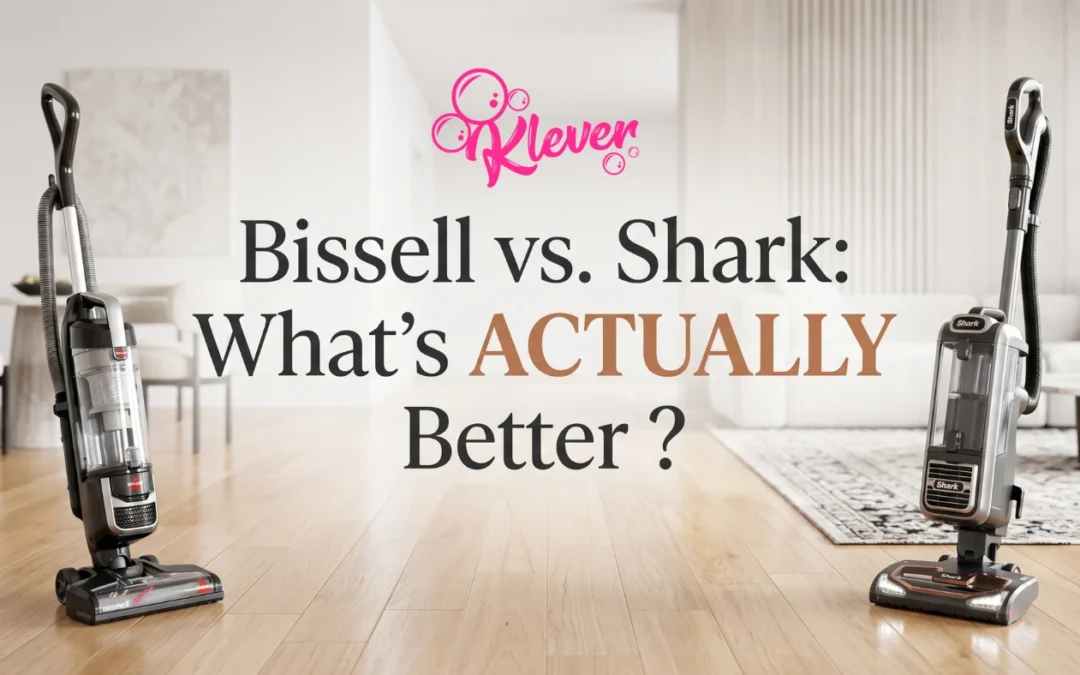
Bissell vs. Shark: Why Cheap Portable Machines Will Never Deep Clean Your Carpet
You're standing in the appliance aisle staring at the Sharks and the Bissells, wondering if dropping a few hundred bucks on a portable unit is a smart move. Fair question. Let's be straight about it: these home machines have a place. But if you think one of them is going to do the same job as a professional clean on your 15 to 25-year carpet investment, you're about to make an expensive mistake.
Here's where they actually fit, and where they fall flat on their face.
Which is the best carpet cleaner to purchase?
For minor, fresh liquid spills — the dog has an oopsie, a kid tips a juice — a portable in the cupboard is genuinely useful. Catch the spill in the first sixty seconds and a Bissell or a Shark can pull most of it out before it sets.
For anything beyond that — ground-in dirt, traffic lanes, a full restorative clean, or a stain that's been sitting for more than a few hours — they're out of their depth. Retail machines don't have the suction to extract the water they put down, and they don't get hot enough to break grease and oils. Use one for a full clean and you'll spread the dirt, soak the underlay, and end up with a carpet that looks worse a week later than it did before you started.
Which is better Bissell or Shark Portable cleaner?
It honestly doesn't matter. Picking between them is like arguing about which butter knife cuts a steak better.
The bigger problem is that carpet cleaning is a chemistry job, and the machine is only one piece of the puzzle. You need to know whether you're working on wool or synthetic, you need to match the chemical to the fibre, and you need to know what the actual stain is made of.
Wool sits naturally at a slightly acidic pH around 5 to 6. Tip a generic alkaline supermarket shampoo into your home machine and you can permanently bleach the dye, crush the pile flat, and leave a sticky residue that pulls dirt back in faster than before. The machine isn't the problem at that point. The chemistry is.
What is the highest rated home carpet cleaner?
Whichever one you buy, the fundamental flaw is the same: weak suction, lukewarm water, and a small dirty water tank.
When the machine puts more water down than it can pull back up, that excess soaks past the face yarn into the underlay. In Auckland's humidity it sits there for days. As the carpet dries from the bottom up, all the dirt and dye it picked up on the way down rides that moisture back to the surface. That's called wicking. When the jute backing gets involved, you get cellulosic browning — permanent yellow-brown stains across the surface that need an acidic chemical treatment to reverse.
Translation: you bought a machine to clean the carpet, and it gave you a new stain you didn't have before.
Do steam cleaners really work on carpet?
Real ones do. Truck-mounted hot water extraction running at 98.9°C with industrial suction is the gold standard, and there's a reason every IICRC-qualified technician uses it.
A retail "steam cleaner" running off a 10-amp household plug and a 12-litre tank is not the same machine. Same name on the box, completely different physics.
And here's the hidden risk most people don't know about: if you apply heat to the wrong stain at the wrong time, you set it permanently. Protein stains — blood, vomit, urine, egg — bond into the fibre under heat and never come out. Tannin stains can lock in if you've already hit them with vinegar. The professional rule is simple: if you're not 100% sure what you're dealing with, don't touch it with heat.
Why are home machines a disaster for pet odours?
This is where home machines really fall apart, and it's not about accidents. It's about that thick, musty dog smell that builds up in any house with a pet — the one you stop noticing until a visitor walks in and pulls a face.
That smell isn't dirt. It's a cocktail of natural skin oils, sweat, and saliva that your dog deposits into the carpet every time it lies down, rolls around, or shakes itself off. Those oils soak into the fibres and the underlay over months and years. Bacteria feed on them. The smell gets stronger.
Now here's where the home machine makes it worse. A Bissell or a Shark uses warm tap water and a generic shampoo. Warm water dissolves those oils and bacteria and flushes them deeper into the carpet, but the weak suction can't pull the contaminated water back out. So instead of removing the smell, you've just rehydrated it, spread it further into the underlay, and given the bacteria a fresh damp environment to thrive in. Twenty-four hours later, the house smells worse than before you started.
Trying to lift baked-in pet odour with a portable machine is like trying to wash a sweaty gym shirt by spraying it with water and stuffing it back in the gym bag. You haven't cleaned anything. You've just made it damp.
The professional fix is a different process entirely. We pre-treat the carpet with an enzymatic odour treatment that actually breaks down the uric acid, oils, and saliva at a molecular level — not just masks the smell with perfume. Then the truck-mount goes in at 98.9°C with massive suction and flushes the broken-down residue completely out of the carpet and underlay. The smell doesn't come back because the source is physically gone, not perfumed over.
That's a $59 add-on for the whole house. It's the single best money you'll spend if you've got a dog.
Where does the dirt go when you steam clean a carpet?
With a portable, a lot of it goes deeper. That's the honest answer. The water carries dirt down into the pile and underlay, and the machine doesn't have the suction to bring it back up.
With a Klever clean, it goes into the dirty water tank in the van and out into the garden as wastewater. Different machines, different physics, different result.
Our truck-mounted Titan 325 runs off a petrol engine. It hits 98.9°C at the wand — for every 10°C of heat, chemical activity roughly doubles, so the difference between 40°C tap water and near-boiling steam is enormous. The heat melts grease and oil that lukewarm water can't touch. The suction pulls every drop back out. Carpets are walk-on dry in 4 to 8 hours.
Trying to clean built-up grease with a warm-water portable is the same as trying to wash a roasting pan full of bacon fat in a cold sink. You smear it around. The actual job needs heat.
The Klever Solution
Keep the Bissell in the cupboard for the small stuff. For everything else, leave it to the gear that's built for the job. Our IICRC-qualified technicians use only safe, non-toxic, WoolSafe-aligned chemicals matched to your specific fibre, and we finish every clean with a slightly acidic textile rinse that resets your carpet's pH back to its natural state. No sticky residue. No overwetting. No wicking. No browning.
Give us a shout on 0800 KLEVER or book online for transparent flat-rate pricing.
Verified Google Rating 5.0 — based on 650+ reviews.