
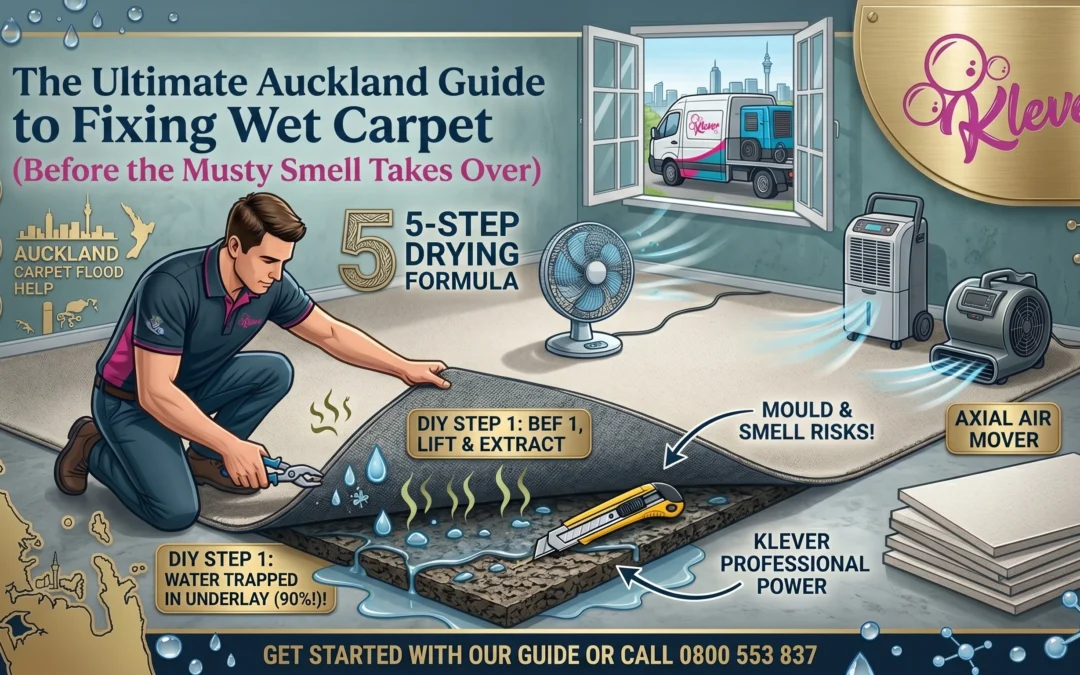
How To Fix Wet Carpet (Before the Musty Smell Takes Over)
Finding a wet patch of carpet in your lounge is enough to trigger a wave of pure panic. Whether it’s a bathtub that overflowed, a washing machine hose that burst, or a sudden winter leak from the ceiling, your immediate instinct is to grab some towels, throw a household fan on top, and hope for the best.
But here is the unapologetic truth: trying to dry a wet carpet from the top down is a complete waste of time. Your carpet is a massive, expensive 15 to 25-year investment. If you don’t treat water damage with proper science, you’re not just risking a damp floor—you’re creating a literal breeding ground for mould, mildew, and permanent, foul musty odours deep in your subfloor.
If you want to save your floors and avoid a costly insurance claim, here is the ultimate, straight-talking step-by-step guide to tackling wet carpet before things get funky.
The 10% Myth: Why Surface Drying Fails
The biggest rookie mistake Auckland homeowners make is throwing a heater or a domestic dehumidifier in the room, pointing a fan at the carpet surface, and thinking they've sorted it.
Drying the surface of your carpet only fixes about 10% of the problem.
-
-
- The Sponge Effect: The foam underlay beneath the carpet weave is made of porous granulated foam chips that act exactly like a giant kitchen sponge.
- Trapped Moisture: This underlay absorbs and traps 90% of the water. Leaving the carpet tacked down prevents this moisture from evaporating.
- The 48-Hour Danger Zone: Within 12 to 48 hours in Auckland’s humid climate, that dark, stagnant space becomes a breeding ground for mould, mildew, and musty smells.
- Total Loss: Once mould takes hold of the underlay, the carpet is effectively ruined, leading to a total replacement bill.
-
DIY vs. Professional Extraction: Know Your Limits
This DIY emergency guide is strictly for small, localized disasters. Use the table below to determine your next steps:
| Scenario | Water Volume | Recommended Action |
|---|---|---|
| Minor Leak | 1 to 3 square metres (e.g., quick bath overflow). | DIY Emergency Guide (Follow steps below). |
| Major Flooding | Entire rooms, flash floods, or water travelling through multiple levels. | Call Professionals/Insurance. Requires industrial extraction. |
| Time Delay | Water has been sitting for over 24 hours. | Call Professionals. The risk of mould is too high. |
5 Steps to Rescue Your Wet Carpet
1. Disengage the Corner
Residential carpets are usually installed using the "stretch-in" method on smoothedge gripper rods, meaning they are not permanently glued down.
-
-
- Walk to the corner of the room closest to the wet area.
- Grab the carpet firmly and pull upwards towards the centre of the room to hear it "pop" off the installation spikes.
- If your fingers slip, use a pair of pliers to gently grip a small tuft of the carpet pile, or use a metal hooking device like a carpet awl. Do not use a kitchen knife.
-
2. Peel Back and Extract
Gently peel the carpet back like an orange skin. The wet subfloor wood or concrete will be dark, damp, and cold to the touch.
-
-
- Use a wet and dry vacuum cleaner (wet vac) immediately.
- Thoroughly vacuum the surface of the wet carpet, the exposed subfloor, and directly over the back of the peeled-back carpet.
- Removing liquid water now saves days of drying time.
-
3. Cut and Hang the Wet Underlay
If the foam underlay is saturated, you must cut out the wet portion.
-
-
- Use a sharp Stanley knife to make clean, straight cuts along the perimeter. Straight cuts make it infinitely easier to tape back together later.
- Take the cut-out section outside and hang it over a fence or clothesline. Gravity will pull the water down, and the Auckland sun will dry it completely. Never leave wet foam sitting on a wood floor.
-
4. Rapid Structural Drying
You are now left with a bare subfloor and the damp carpet backing, both of which must be dried completely. The secret to rapid drying is Air Movement + Warmth = Evaporation.
-
-
- Point as many household fans as possible directly at the wet surfaces to disrupt the boundary layer of cold, damp air.
- Turn on a portable heater to warm the room and increase the air's water-holding capacity.
- Crucial Safety Warning: Never place heaters directly touching the carpet, underlay, or walls, and never leave them unattended.
-
5. Relay the Carpet (With Caution)
Wait until the subfloor is 100% bone-dry. Relaying carpet over a damp floor will cause moisture to wick back up, leaving dark brown water stains (cellulosic browning) and a musty smell.
-
-
- Drop your dried underlay back into its slot and use heavy-duty tape along the straight cuts.
- Smooth the carpet back over the top.
- Pro Tip: Wet carpet stretches and goes wavy. To prevent ugly ripples, the carpet needs to be power-stretched back onto the batten using a knee kicker. If you do not stretch it evenly, you will ruin the backing.
-
When to Call the Auckland Carpet Experts
Tackling a wet carpet yourself is a fantastic emergency response, but you have a strict 24-hour window before things go pear-shaped.
Standard household equipment simply cannot match the power of commercial flood restoration gear. At Klever, we deploy petrol-powered truck-mounted machines to extract thousands of litres of water, followed by low-grain refrigerant (LGR) dehumidifiers and commercial air movers. As a little side note: If you're in Australia an need a hand with the flood restoration equipment then check out Restoration Warehouse
If your carpet is squishy underfoot, or if you want your floor stretched back to pristine condition, give us a shout on 0800 553 837. We have the tools, the expertise, and the IICRC-qualified technicians to get your home back to 100% normal.